
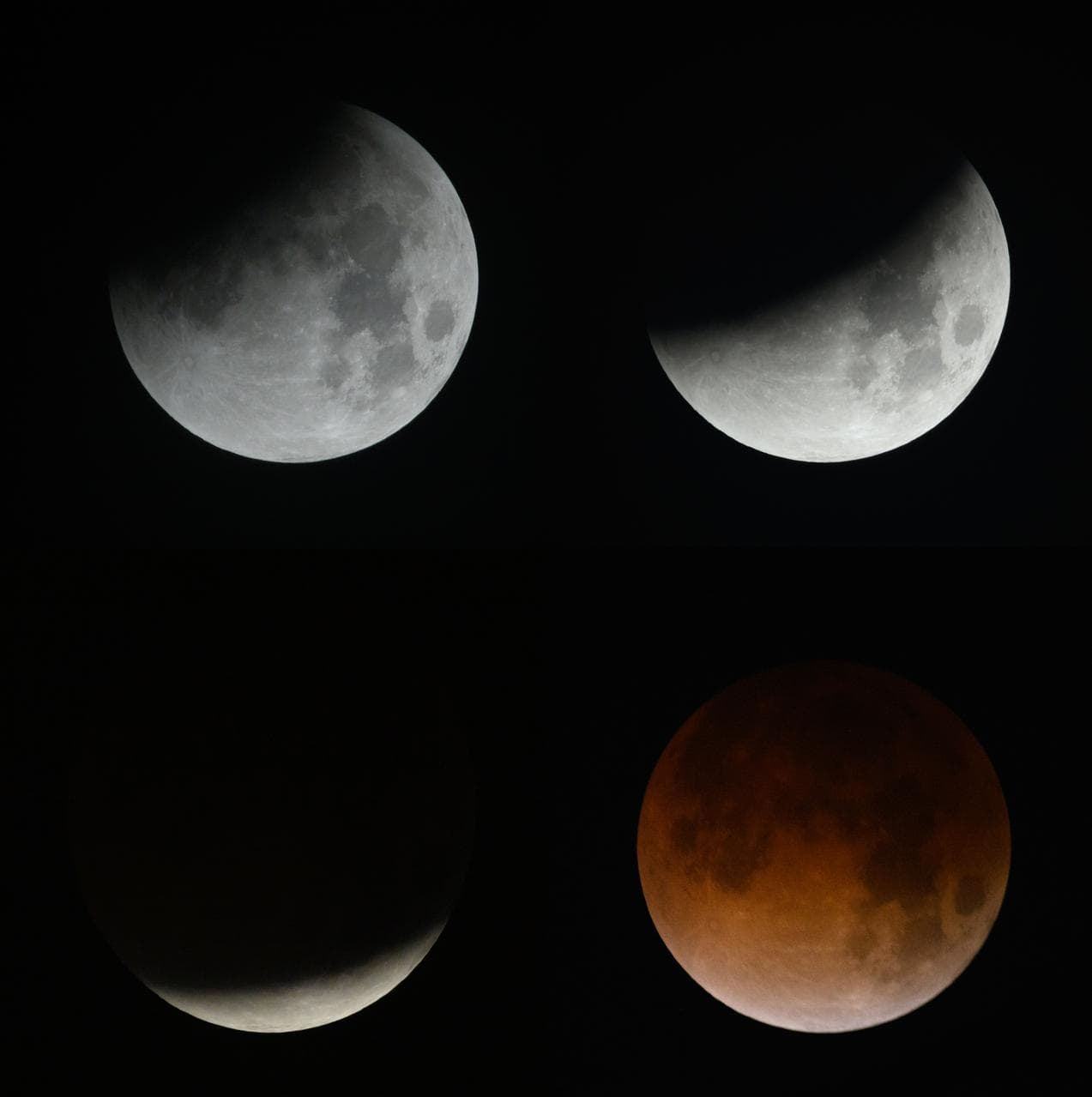
Earth's shadow nearly covers the Moon
A deep partial lunar eclipse reaches a calculated obscuration near 0.966 at global peak.
scheduled
The meaning behind the moment
Unlike a solar eclipse, the same broad lunar-eclipse phase is shared across Earth's entire night side.
02 · ENJOY IT FROM HOME
Drag the Moon through Earth's shadow
Compare the Moon before, during, and after it crosses Earth's shadow; the red color comes from sunlight filtered through Earth's atmosphere.
- Start with the physical arrangement.
- Notice what changes from Earth's point of view.
- Connect the geometry to what a person can actually experience.
Useful without a location; richer with one
The global event and indoor experience are complete above. Add a city on This Week for a localized time and an honest easy / possible / not-visible result.
No equipment required
You need the Moon above your local horizon during the eclipse. No eye protection is required for a lunar eclipse.
Source, calculation, and revision
- Primary source
- Astronomy Engine validated against USNO
- Last checked
- 2026-08-10T23:00:00+00:00
- Calculation
- astronomy-engine@2.1.19
- Precision
- exact; weather is not included
- Media
- Eric Bordelon · NASA Media Usage Guidelines
We’ll keep this page current
After the event, this durable page will preserve the result, official replay, or a concise correction without silently rewriting the earlier revision.