
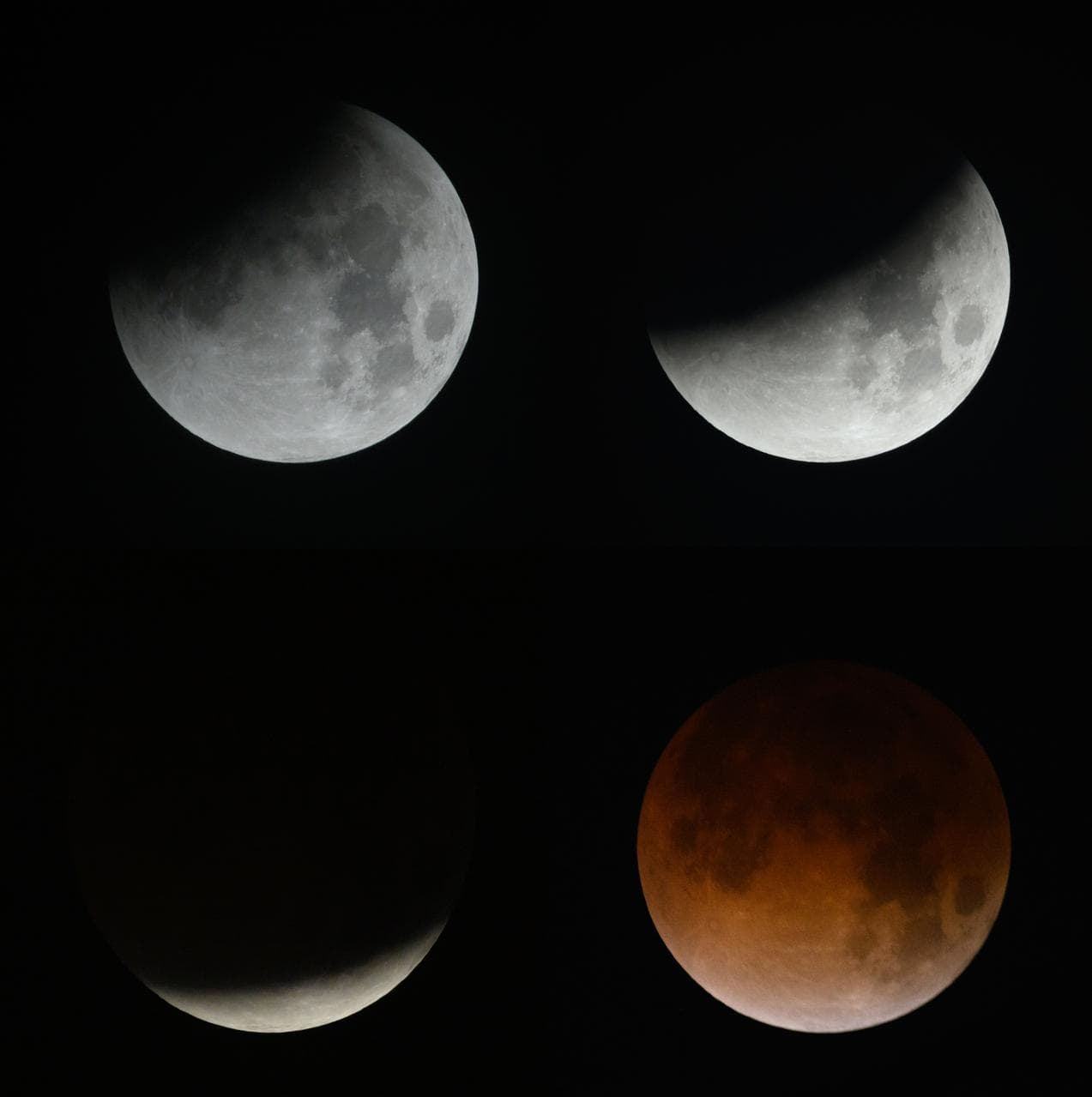
The March total lunar eclipse turned the Moon copper-red
Earth's shadow crossed the full Moon, and observers documented the color produced by sunlight filtered through our atmosphere.
The meaning behind the moment
The outcome made Earth's own atmospheric ring visible on another world.
Compare the eclipse outcome frame by frame
Compare the Moon before, during, and after it crosses Earth's shadow; the red color comes from sunlight filtered through Earth's atmosphere.
- Start with the physical arrangement.
- Notice what changes from Earth's point of view.
- Connect the geometry to what a person can actually experience.
External state: ended. The on-site explainer above remains available as On-site shadow explainer.
Useful without a location; richer with one
The global event and indoor experience are complete above. Add a city on This Week for a localized time and an honest easy / possible / not-visible result.
No equipment required
The event has ended; the indoor comparison remains the primary action.
Source, calculation, and revision
- Primary source
- NASA Image and Video Library
- Last checked
- 2026-08-10T23:30:00Z
- Calculation
- astronomy-engine@2.1.19
- Precision
- exact; weather is not included
- Media
- Eric Bordelon · NASA Media Usage Guidelines
Outcome recorded
A NASA composite from New Orleans records the Moon's progression through totality and back into sunlight.